

Fesia Grasp
(FES) finger & hand rehabilitation

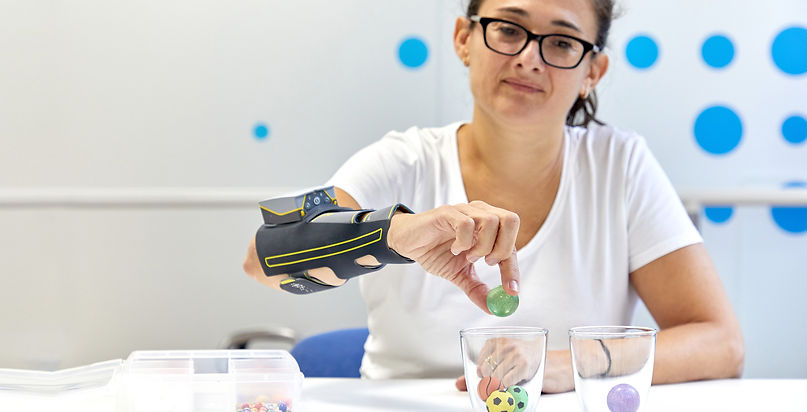
Fesia Grasp is a rehabilitation device based on functional electrical stimulation (FES) that generates flexion and extension of the wrist and fingers, designed for people with motor impairment of the upper extremity due to injuries or diseases of the nervous system.
Read more on functional electrical stimulation (FES)
High sensitivity of movements

Thumb

Wrist

Index

Fingers 3,4,5

Lateral
deviations

Open hand

Pinch grasp

Pamper grasp
Fesia multi-field electrode

16 movements, 1 electrode
It allows to selectively stimulate until 10 analytical and combinable movements

High repeatability
Increases the repeatability between sessions without needing to move the multi-field electrode.
For a variety of pathologies

Stroke

Spinal Cord
Injury

Traumatic brain
injury

Multiple
sclerosis

Cerebral
palsy

Fesia Pro
By your side on every step
A guided and intuitive app to:
-
Configure Fesia Grasp.
-
Manage and follow your patient’s progress.
-
Check the device’s performance.


Tone reduction
Protocol aiming to regulate the tone in people with generalized spasticity in the limb or focalized in specific muscles.

Repetitive task
Protocol for training of specific tasks repetitively, adapted to the patients' motor skills to perform an active therapy.

Activities of daily living
Protocol that integrates the movements provided by electrical stimulation into activities of the daily living.
(FES) Functional Electrical Stimulation
Our technology is the solution to the classic problems of Functional Electrical Stimulation.
Our goal has always been to bring the use of functional electrical stimulation to any rehabilitation therapy so that anyone can use it in an easy, intuitive and effective way, to benefit from all the advantages of this technology.
Thanks to our technology, we have created products that are controlled by a simple application.
-
It adapts to the needs of a wide variety of patients, with different stimulation protocols.
-
Depending on the patient’s stage of rehabilitation, we can create different types of movement; from more analytical movements to more functional movements.
-
Easy integration in the clinic; you don’t have to adapt your way of working, the device adapts to the objective you and the patient have set
Focused in Neurorehabilitation
Based on this, we have developed two solutions, with a common principle: neurorehabilitation.
FES is an effective technology if used correctly in rehabilitation processes in those patients with paralysis or paresis of the musculature due to diseases or injuries, such as:
Electrical stimulation has two effects:
-
It contracts the muscle, and therefore generates a specific joint movement.
-
Afferent stimulation, by which the electrical impulse travels through our nervous system, stimulating neuroplasticity, thanks to which new nerve connections are created.